
Microchip PIC16F716 Microcontroller: Architecture and Application Design
The Microchip PIC16F716 is a high-performance 8-bit microcontroller based on RISC architecture, offering a cost-effective and versatile solution for a wide range of embedded control applications. Its balanced mix of core features, integrated peripherals, and low power consumption makes it particularly suitable for consumer, industrial, and automotive systems.
Architectural Overview
At the heart of the PIC16F716 lies the robust 8-bit RISC CPU core. It features a 14-bit wide instruction set (35 instructions) with a two-stage pipeline, enabling most instructions to execute in a single cycle, achieving a throughput of up to 5 MIPS at 20 MHz. The core operates with a wide voltage range (2.0V to 5.5V), enhancing its flexibility in battery-powered designs.
The memory organization includes 2K x 14 words of Flash Program Memory and 128 bytes of RAM for data storage. A key architectural strength is its 128 bytes of EEPROM data memory, which allows for the non-volatile storage of critical data—such as calibration constants or user settings—without requiring external components.
Its peripheral set is thoughtfully integrated:
5-channel 8-bit Analog-to-Digital Converter (ADC): Essential for interfacing with real-world analog sensors like temperature or potentiometers.
Two Timers (TMR0 and TMR1): Provide precise timing and event counting capabilities.
Capture/Compare/PWM (CCP) module: One module that can be configured for input capture, output compare, or Pulse-Width Modulation (PWM) output, crucial for controlling servo motors, LEDs, or generating simple analog voltages.
Universal Synchronous Asynchronous Receiver Transmitter (USART): Facilitates serial communication (RS-232, RS-485) with peripherals like PCs, GPS modules, or other microcontrollers.
In-Circuit Serial Programming (ICSP): Allows for easy and convenient firmware updates directly on the circuit board.
Application Design Considerations
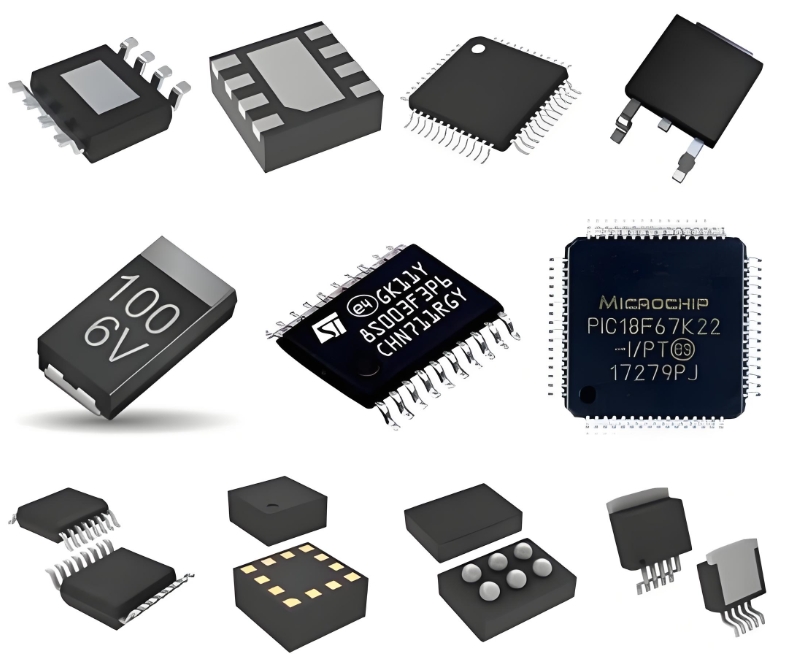
Designing with the PIC16F716 involves leveraging its integrated features to minimize external part count and reduce overall system cost and complexity.
1. Analog Sensing Systems: The 5-channel ADC is ideal for multi-sensor applications. A typical design for an environmental monitor would connect temperature and humidity sensors to the ADC pins. The internal EEPROM can store calibration data for each sensor, ensuring accurate readings. The converted digital values can then be displayed on a local LCD or transmitted via the USART to a central host.
2. Motor and Power Control: The CCP module is central to control applications. In a DC motor control system, the CCP module can generate a precise PWM signal to regulate motor speed. The duty cycle of the PWM wave, which controls the speed, can be adjusted based on inputs from a potentiometer connected to the ADC or commands received through the USART.
3. Low-Power Design: For battery-operated devices, leveraging the microcontroller's SLEEP mode is critical. The device can be programmed to wake from sleep on specific events, such as a timer overflow or a change on a pin (external interrupt), perform a measurement or task quickly, and return to sleep. This dramatically reduces the average power consumption, extending battery life from months to years.
When designing the circuit, careful attention must be paid to the PCB layout, especially for the ADC to ensure a clean and stable reference voltage. Proper decoupling capacitors near the power pins are mandatory for stable operation.
The PIC16F716 stands as a testament to the power of integration in embedded design. It successfully packs a capable CPU, essential memory (including valuable EEPROM), and a critical set of analog and digital peripherals into a single package. This architecture empowers designers to create sophisticated, reliable, and cost-effective solutions for a vast array of real-world control and sensing applications, from simple automation to complex interactive products.
Keywords:
PIC16F716
RISC Architecture
Pulse-Width Modulation (PWM)
Analog-to-Digital Converter (ADC)
EEPROM Memory

